In 1961 the Whitechapel Gallery held a ground breaking exhibition of Rothko’s paintings. Following a Jackson Pollock exhibition in 1958 at the same gallery the effect on art in Britain was profound. Sandra Lousada captured the mood in a series of mostly black and white photographs as the public absorbed the new world of Abstract Expressionism. The Whitechapel Gallery currently has a room dedicated to examining the exhibition in photographs, letters and other documents. There is also one large Rothko – Light Red over Black, 1957
After visiting the frenzy of Frieze Art Fair 2011 at Regent’s Park the photographs of the original Rothko exhibition show a slight shock and quiet reverence towards the canvases.
Until 26th February 2012, Whitechapel Gallery, E1.
Amongst the huge amount of work on display one piece stood out for me. At the Frith Street Gallery was Cornelia Parker’s 30 Pieces of Silver (With Reflection), 2003 . A beautiful, thought provoking and quite mesmerising work. The metamorphosis of the pieces after the have been crushed flat was fascinating as they were side by side with the original. The whole piece floats mid air like a giant Madhatters Tea Party without the guests.
A close second was a film by Ben Rivers called This Is My Land, 2006 following a hermit like man who lives in a forest. Shot in black and white with many scenes covered in deep snow there is a stillness and sensitivity which pervades. The sound echoes this, with each crunch of a footstep in the snow. The film has a meditiative effect and shown in a small roughly built shed was an oasis of calm amongst all the go-getters of the artworld preening and schmoozing outside.
Properly outside was the Sculpture Park which was open to the public and felt relaxed compared to the uptight nature of 173 galleries squeezed together in a giant marquee. An opportunity for everyone to wander, sit and appreciate art in the open.
Circle Dance 201 by Tom Friedman (Stephen Friedman Gallery)
Seer (Alice 11) 2005 by Kiki Smith (Timothy Taylor Gallery)
Photography at Frieze Art Fair is represented by some major galleries but in terms of quantity it is fairly low amongst the huge amount of art on display. There is photography exhibited by galleries based in Eastern Europe, Russia and India but overall the quality is uneven and it is the household names in the art world who dominate.
Andreas Gursky exhibits at Spruth Magers showing Dubai World 111, 2008. It has the hallmark of other Gursky work, large in scale, big on statement. It represents mans desire to recreate the landscape but at the same time recreate the world. It’s the type of work well suite dto a world where money washes around but the current climate of economic downturn calls for a different approach. As an artist it will be interesting to see where he goes next, having nailed his colours firmly to the mast of capitalist imagery full of consumption on a huge scale.
Dubai World 111, 2008. Andreas Gursky.
In contrast the work of Wolfgang Tillmans deals with phtography in a quieter, smaller way that feels more relevant and contemporary. Abstract work is represented here by Freischwimmer 190, at Maureen Paley, an image created in the darkroom full of poetry, mystery and also a lurking darkness that remains unknown and unresolved. Two more traditional photographs are exhibited at Galeria Juana de Aizpuru. In Flight Astro 11, 2010 merges the graininess and texture of film and pixellated nature of stars and constellation which together creates a surface pattern that shows both seamlessly linked together in union. Sunset Reflected, 2007 is straightforward enough but mixes darkness with Autumn melancholy and finally bright cloud – almost three landscapes within one, unsure of what they are meant to be.
In Flight Astro 11, 2010 (left) Sunset Reflected, 2007 (right)
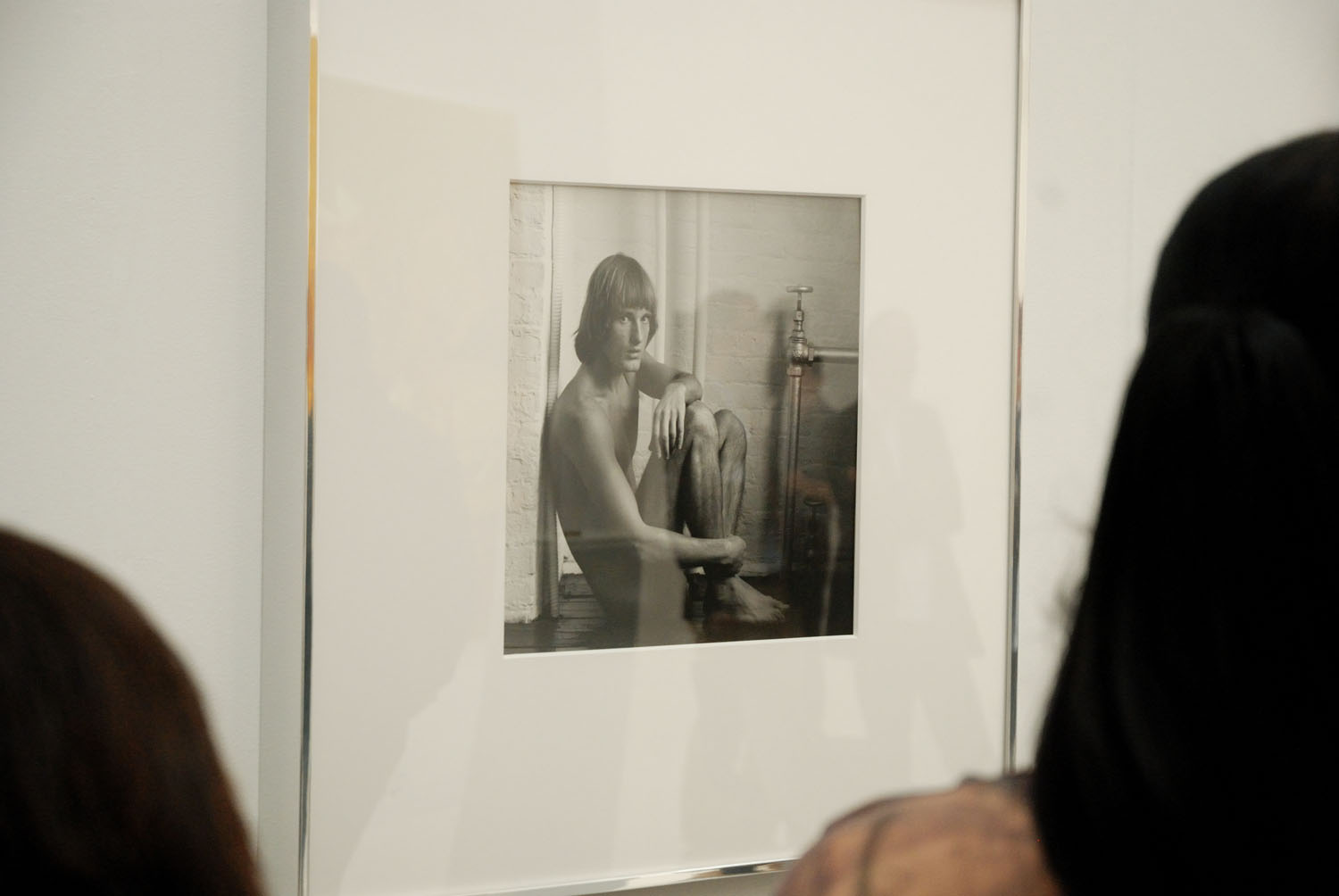
Five black and white Robert Mapplethorpe prints were a delight to see. Marcus, 1978 and Peter Berlin, 1976 are beautifully sensitive portraits of young men full of vulnerability and honesty. Knowing how the community was going to be devastated by the AIDS epidemic makes them even more poignant. Haunting.
Peter Berlin, 1976. Robert Mapplethorpe.
At a similar time Nan Goldin was in New York photographing the life of Cookie Mueller following her slow demise as an actress addicted to heroin. A series of 15 images claws away at her mask of hair and make up as she resists the surgical questions of the camera. It’s a battle she finally lost in April 1989. The work of these two artists reaffirms the strenth of photography to document but also to probe, question and reveal. Maybe it’s the work of people such as Mapplethorpe and Goldin who point us in the direction that art photography will go in the next few years. After years of being grand and oversized maybe it’s time to be intimate and personal again.
The art worlds most talked about contemporary photographer Taryn Simon has cemented her status with a solo show at Tate Modern. Represented by the Gagosian Gallery and with a wealth of useful connections Simon threatens to put photography once again in the public eye.
This show however will come as a disappointment to many people who know what to expect from “great photography” and prefer an artform that is accessible and less likely to challenge them. Recent fine art photography has been large in scale and predominantly single image, such as the work of Andreas Gursky and Thomas Struth, which is easily understood. What Simon does in her work by contrast is to isolate subjects from their surroundings and bring a deep level of reinterpretation to what is at first glance a straightforward set of circumstances. She choses a difficult path. Her work involves not just months but years of preparation and the results are not easy for the viewer. The casual visitor to her show will be ill- prepared after meandering through galleries of easy viewing.
Each work is set out as a grid of images - each related to one another. The multiplicity has a numbing effect but it lulls you into a false sense of security. People are connected by bloodline, even animals, in this case seemingly identical rabbits in different positions. The grids are democratic, symmetrical, unremarkable, the portraits straightforward – it is a direct challenge to power we associate with a photograph on a gallery wall. But…there is always more, a story, a link, a connection, a moment that has bound these people these images together.
Babloo Yadav, aged circa 11/12, and Mukesh Yadav, c10/11, of Azamgarh, Uttar Pradesh, India. Copyright: Taryn Simon
I was fascinated by the series of relatives from a Lebanese sect who believe in reincarnation. The fact that the same person reappears time and time again due to this belief system is mundane visually but the repetition has real meaning here, this is image reproduction which baffles the mind. How could this person be the son and the father to his own father? In this context a duplicated image confuses and distorts the normal associations we have of multiple images.
There are complex ideas here at work which is the hallmark of Simons approach. She seems to revel in the threads, meanings, associations beyond the straight photograph. Her concern to establish a real depth actually pushes her further wawy from her role as a photographer. Only recently she declared “I think I”ve just gotten tired of photography in a way and am trying to use it as a simple recorder..” (Observer 22/5/11 Sean O'Hagan article)
In stripping away any embellishments in her photography she seems to be saying this is all photography is, nothing more and there is far more interest beyond the image. The image, the print, the object has become purely a starting point, a window to a subject. She is constantly questioning the validity of photography and the conclusion in this exhibition is that it is bordering on the meaningless. The grids where portraits are missing, because someone has died or has disappeared, appear to have the real power here. Simon perversly celebrates the empty space, and the narrative that it provides.
Simons progression as an artist one imagines could lead to her discarding photography altogether. To some people that may be no great loss, but her rigorous questioning and interrogation of a medium that we happily accept provides us with a real depth and intelligence often lacking in art photography today.
One of my screenprint posters with stencilled vinyl from Somebody Anybody at Exposure Gallery, London. This one was requested recently but few remain as most of them were used for promotional purposes - ending up on lamposts around the West End. Surprisingly some lasted nearly a year before disappearing. I wonder who took them...
As the third in a series of photography exhibitions at the Whitechapel, Thomas Struth's exhibition impresses straight away. Two huge prints welcome the visitor - Audience 06 and Audience 01 are both scenes from an unnamed Florence museum. It is a comment on the art lover that greets the art lover here as they arrive. It shows people gazing in a large space at an artwork out of the photographic frame. It is typical of a large body of Struths work showing people in large spaces, against large manmade backdrops often with religious backdrops. There is a wow factor here in the size of the print, the scale of the building and astonishment on some faces.. Is there more to it?
Audience 01, Florence 2004
Curiously some of his early work in black and white showing mostly deserted streetscenes holds more meaning and mystery. Maybe the historical context adds weight and interest as most of the photographs are from the early 1980s. They are much smaller but have a quiet impact that implies a living breathing fabric to the architecture of the city.
Crosby Strret, New York/Soho, 1978
Struth chooses to make singular statements with his photographs. There is a sense that each is a singular comment and this probably has come from his clear objectivity that he has always used. To show scenes “as they are” and without embellishment is an approach straight from the German school of Bernd and Hilla Becher which found favour in other artists such as Andreas Gursky, Thomas Ruff, Thomas StruthandCandida Hoffer. There are critics of this approach including Paul Graham (whose exhibit preceded this one coincidentally) who is more of a fan of a different approach by the German Michael Schmidt. Graham prefers bodies of work where images build to make a more coherent statement than the powerful shot delivered to impress.
Struths family portraits retain a powerful understatement that is sometimes missing in the large scale single statement photographs. One feels different characters within a group, who cling to individuality but whose identity and connectivity cannot be ignored. A sense of the unmentioned pervades, the family secret not yet told. I was surprised how this series grabbed me.
The Ma Family, Shanghai. 1996.
Overall a strangely uneven show, but nevertheless with many points of interest for viewers with different tastes in the subtleties of photography.